
Speak for yourself
on "boring" Asian American lit

My relationship to Twitter right now is extremely functional. I remain on the hellsite for two reasons; 1) it keeps me informed on pop culture, which gives me writing fodder, 2) it fuels my outrage, which wakes me up in the morning. Most days, my first instinct is to fish my phone out of the sheets, blearily open the website (not the app, which I deleted hoping to discourage frequent visits, though this strategy has not been successful) and scroll until I stumble on some take that gets me mad enough to jolt alert and away from the sweet pull of extra sleep. It does for me what caffeine simply can’t.1
The problem is that I am the most easily rage-baited person in the world and, I’ll admit, a bit of a masochist. If I see something that disagrees with me, or disgusts me, I will click on it. I will scan the comments section. I will peruse the quotes. I’ll do all in my capacity to absorb every shitty angle, the consensus and counterarguments.
Why I’m like this, I don’t know. It’s not doing anything great for my personality, or my outlook on life, and in phases when I find myself in a perpetually negative state of mind, I know it’s time to force a T-break. Lately, I’ve noticed that when my roommate brings up some celebrity or another, any gossip or hot topic from Heated Rivalry to Manon’s hiatus, I immediately start spewing all I know about the basest, darkest, discourse muddying the cesspools of these forums. I don’t repeat this stuff to validate it, rather to say, isn’t it obscene how cruel and out of touch the online troglodytes can be? She looks at me with gentle pity, like I’m the one wearing the tin foil hat. I’m equipped with this info but at what cost?
This morning I saw something that pissed me off. And it connects to an issue much larger than me and my opinions, but since this whole debacle concerns literary fiction, and the limited scope of one’s own experiences, I’m going to speak from the “I” perspective here.
The tweet that got me hot arrived off a wave of discourse from an earlier post, which I also peeped this week. Apparently, a writer named Rucy Cui won a Stegner fellowship and someone presented a screenshot of her prose, with little comment but loads of implicit shade: “This author landed a 2-year creative writing fellowship at Stanford, which pays $75,000 per year.” You can read the offending selection below.
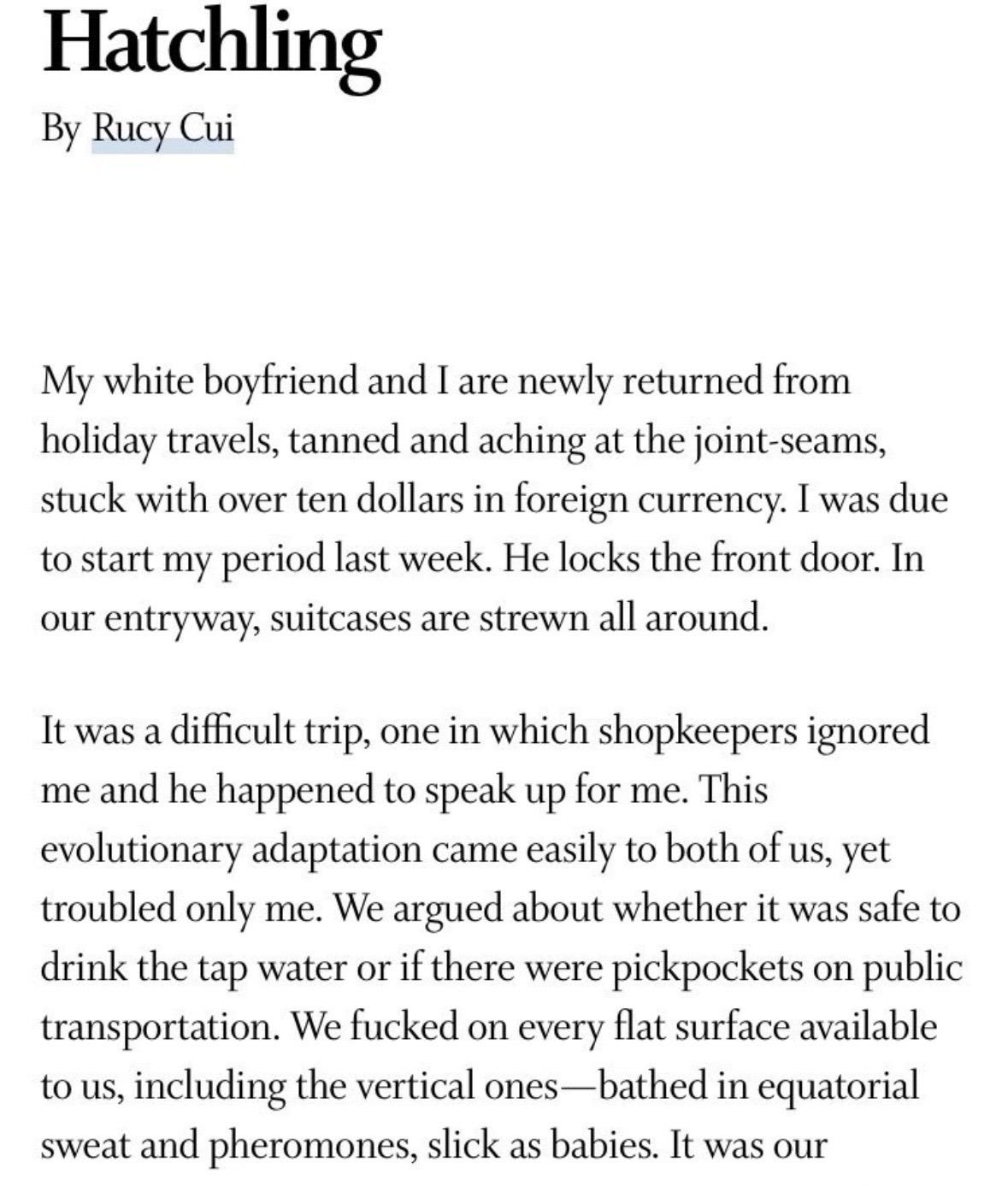
So, yea…that’s pretty bad. The dogpile that followed affirmed how fed up readers are with this particular voice in contemporary lit. Still, my initial response was to fall lightly on Cui’s side — because in all Twitter clashes, one is made a referee, and must decide on a side. As someone who judges all kinds of art (and then writes about it on this substack), my personal rule is that I do not publicly denigrate any emerging artist within my own discipline, especially for getting an opportunity I might want myself. I reserve my snark for industries I am not a part of. Unless a writer’s work is actually offensive, I find it gouache to come online and say this person doesn’t deserve that prize (saying it privately is a different story). In Miami last month, an often awarded writer told me how Twitter poets had bitched about her own Stegner acceptance because she happens to be well-connected. In their words, she “gets everything.” We rolled our eyes together. Even in situations when it’s warranted — and in Cui’s case it may be — hating on your competitors out loud is uncouth. And hating when they’re doing things you’re not and wish you were just looks embarrassing.
To be clear, I understand the collective gag reflex triggered by Cui’s work here. The narrator’s “trouble” by her boyfriend’s command of a language she doesn’t speak well enough to communicate in, the tourist talk of tap water and transit dangers, the puzzling description of their coital bodies as “slick as babies,” comes across as information nobody asked for. As a trope, or meaningful social arrangement, the Asian Girl with a White Boyfriend is commonly scrutinized in life and literature — to diminishing returns. At this point, Cui’s interracial anxiety is trodden ground. Even less compelling than the Asian Girl with a White Boyfriend is the Asian Girl’s inner strife about dating him. This is why, when I had a White Boyfriend, I declined point-blank to internalize any messaging which suggested I should feel ashamed about it (see also, my refusal to internalize the Bisexual Girl with a Boyfriend’s shame).
I remember going to dinner one time with a writer I very much admire, whose work grapples with inherent bias in relationships between white men and Asian women. She told me that, without exception, all white men fetishized their Asian girlfriends. It was impossible to exist in a relationship in which this wasn’t happening. I thought that was a good moment to reveal that my ex (at the time, my boyfriend) was white, and it was momentarily awkward but I laughed and conceded I saw where she was coming from. I wasn’t offended, in part because I disagreed with the totality of her statement, in part because, if there was some truth to the generalization, I didn’t feel it applied to my relationship. My ex had never dated another Asian woman, wasn’t weirdly enamored with Asian cultures, and didn’t even know my racial background until I clarified — maybe I’m speaking from an intrinsically mixed perspective here. If I ever felt unsettled about our relationship, the discomfort came not from any external presumptions, but from the deeply personal fear of having white looking children — that their looking white would classify them as such, that that classification would signify my erasure from my own lineage. That I might someday wake up in a family of white people, look around the breakfast table and realize my closest relatives don’t relate to me or my experience of being.
But I also wasn’t offended because I thought it would be lame to be offended. Like many kinds of mixed people, Wasians have recently emerged as a particularly acceptable target for online mockery, and the relationships that produce them are also subject to scorn. But when I see Asian women put this struggle, or their angst about it, in writing, I sometimes feel a bit irritated. Like, yes, I get that it can be hurtful to post your partner, or bring him into Asian spaces, and feel people making assumptions based on factors beyond your control, judging you as perpetrators of an uneasy social pattern, not individuals in love. But I also feel like, as long as you’re not dealing with a fetishist, or repeating a “preference” across either of your dating histories, why let anybody tell you otherwise?2 As I once heard on Love & Hip Hop Hollywood, “If the shoe fits, wear it. If not, you ain’t Cinderella.”
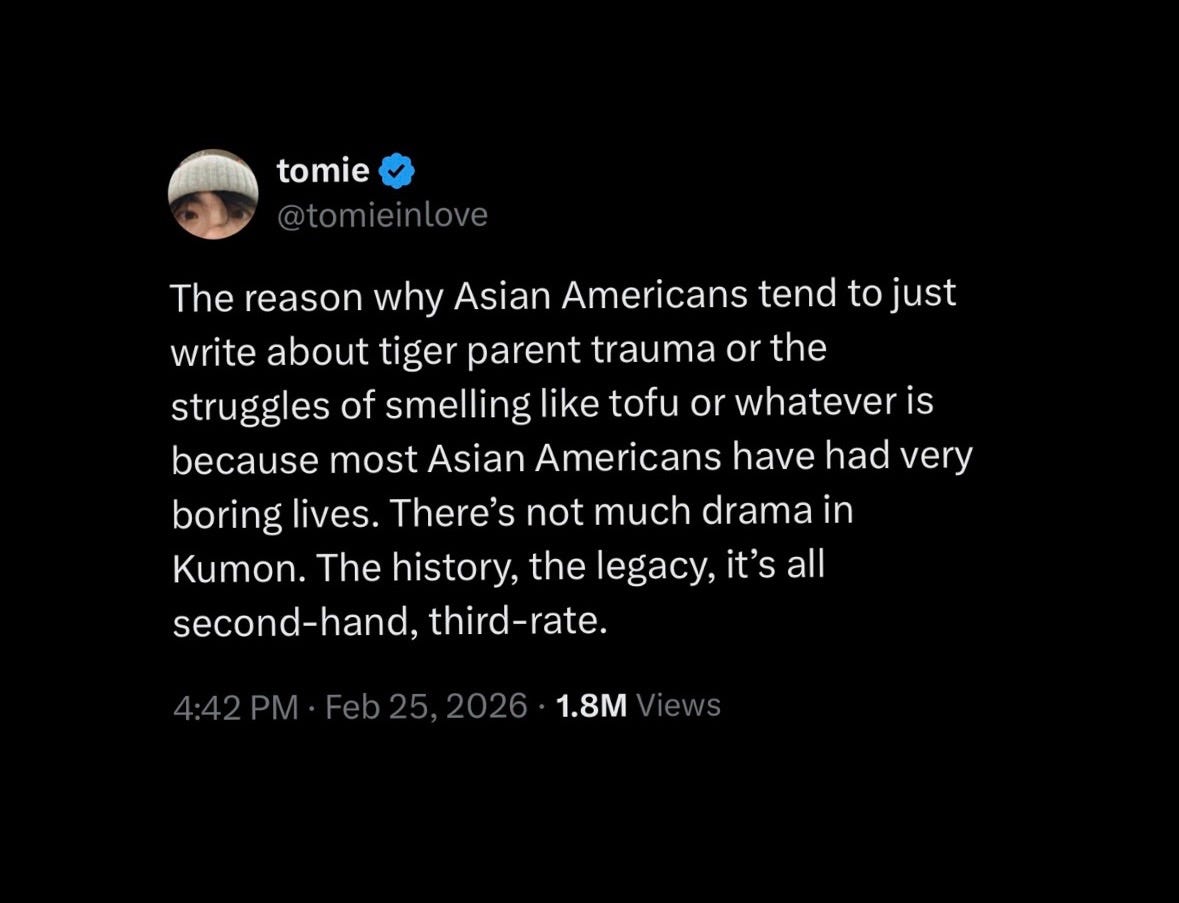
Anyway, the tweet that sparked my ire today was not Cui’s screenshot, which made rounds but then disappeared from my radar. It was an offshoot of the discourse posted by user @tomieinlove. They authored the following bullshit:
“The reason why Asian Americans tend to just write about tiger parent trauma or the struggles of smelling like tofu or whatever is because most Asian Americans have had very boring lives. There’s not much drama in Kumon. The history, the legacy, it’s all second-hand, third-rate.
The Asian American experience is deracinated and diluted and banal and as faintly-flavored as a can of LaCroix. There is no Asian American experience, really, that stirs the heart. In being persecuted we’re lesser, in achieving we’re lesser. The source material is mid.”
After I read this, I went to spit in the sink. Once my blood pressure lowered, I started thinking about the person behind this tweet, and why their comments bothered me so bad. Beyond the smugness, and self-hatred, so deeply entrenched in the wording, I am fascinated by the profound ignorance displayed here — even in hyperbolizing for likes and views, who can say, with their entire chest, that their entire racial group is inherently dull? Only someone who is telling on themselves.
I’m so sick of educated, suburban, middle class East Asians like this poster projecting their experience onto an entire population. They speak for the whole, because the only Asian Americans they’ve encountered, and that exist in their imagination, are those who share and reflect their own lives. The Kumon Asians. The Tiger Children. Of course, this belies extraordinary privilege, as well as a lack of knowledge and curiosity. Among racial groups in the U.S., Asian Americans have the highest income inequality rate — a chasm between top earners (the doctors and tech overlords that OP seems to think represent the majority) and those at the bottom, many of whom are refugees and their descendants. In NYC alone, 20-30 distinct ethnic groups fall under the category. How many Asian Americans must be sampled to conclude that “most” of us live “boring lives,” and who gets left out of such a poll? Does @tomieinlove really believe all these peoples, from all these places, share the same upbringings, aspirations, identities? What exact life experiences, or even cultural ones, does OP have in common with Pakistanis in Queens or Cambodians in Stockton? And how enclosed in their own boring bubble must they be to dismiss the possibility of an AA experience that does not mirror their own “deracinated” “diluted” “banal” “faintly-flavored” existence?
The idea @tomieinlove upholds here (consciously or not) is probably the most pervasive myth about our communities — that all Asians are the same. Before the term “Asian American” was created by student activists in the ‘60s and ‘70s, the even more amorphous “Oriental” label was extended to any person of Asian descent. In coining “Asian American,” those student activists aimed for sharper definition, and to foster solidarity between disparate ethnicities and with other racial justice movements. It was a political identity designed to respond to (and join with) social unrest, and stimulate a radical change in how Asians understood themselves and their position in America.
In the tweet, OP characterizes Asian Americans, and AA writers, as inherently average, contained within some vague middle of a racial hierarchy — lesser persecution, lesser achievements. This is another common idea, that Asians remain the illegible variable, the hard to place “other,” that complicates a Black-White binary. Asian American identity has always been defined in contrast (and comparison) to other groups, which is where I think @tomieinlove’s claim that our histories are “secondhand” comes from. The truth is, our histories are not second to, but intimately entangled with all Americans. Our positioning(s) – proximate to but always distinguished from whiteness, at times posed against or aligned with Black people – illuminate the shortcomings and variability of racial classification systems. Scratch the surface of our history and you’ll find that the stories of Asian presence in America are high-stakes and large-scale, legacies of war, imperialism, captivity. The source material is actually full of narrative potential, if you care to do any research at all.
Maybe the silliest part of OP’s framework is its simple calculation; lack of diverse narratives in AA literature equals lack of diverse AA experiences. Boring AA authors equals boring AA lives. This equation doesn’t take into account a publishing industry that rewards trends and incentivizes pretty much all writers of color to write about race and racial trauma because those topics sell. The inverse implication here is that white authors lead interesting lives and thus, write interesting stories, which is just so obviously not the case. For every AA writer hawking “cut fruit diaspora” poetry, or the kind of “stinky lunch,” generational trauma tales that OP so disdains, you can bet there are a hundred more white authors doing perfectly well with their depressed housewife and quarter-life crisis novels. I’d say those narratives are just as, if not more, mundane and definitely deracinated. @BobaCyclist put it better than me when they retweeted, “This kind of self-pity towards white people (whom you find interesting, dramatic, and full of history, unlike us? Lol) needs to go.”
The Asian Americans who raised me in no way resemble the ones @tomieinlove purports to represent us all. They were Harlemites, hippies, movement people, artists, disruptors, freedom fighters. The elders in my family would sooner reward their children for getting arrested at protests than getting straight As. They believed in good trouble and building towards liberation, not generational wealth. They did not aspire to whiteness, nor were they ever particularly proximate to white people. These are the tenets I grew up believing Asian American identity represented — art, activism, revolution, community. Never assimilation. I know that my experience is exceptional, and that being multiracial (specifically being Black) gave me a very distinct upbringing from other Asian Americans. Still, I am only as different as we all are.
I want more Asian American narratives than the ones that get packaged, clipped and repeated most often, then made to exemplify the whole. I want more types of writing and more writers than the ones that get platformed or unfortunately dragged online. I want characters other than Tiger Moms and White Boyfriends, ideals beyond the American dream. I want all the AA stories I can get, because there truly is no shortage of them, and for everyone to understand that a narrow scope only betrays a narrow mind. Broaden your perspectives. Read widely. Speak for yourselves.
Is this what spiking cortisol means? I don’t know science
If you are doing that, then maybe it’s good for you to sit with some trouble, some reflection
Something so satisfying about seeing a hater-hater get hated on by a lover-hater